Concentrating light at interfaces— turning it into function.
We control the propagation, localization, absorption, and scattering of light at nanoscale interfaces between metals, dielectrics, organic thin films, and molecules. By combining propagating and localized surface plasmons, we create optical functions for sensing, photovoltaic conversion, photothermal conversion, and photoelectrochemical devices.
Three optical phenomena, engineered at one interface.
We tune interface geometry, material composition, grating period, nanoparticle spacing, and the surrounding refractive index to concentrate optical energy at the required position and wavelength.
01 / PROPAGATION
Propagating surface plasmons
Surface waves traveling along metal–dielectric interfaces are excited with prisms or periodic gratings. Their refractive-index sensitivity, directionality, and controllable dispersion support optical measurement and light transport within devices.
02 / LOCALIZATION
Localized surface plasmons
Gold and silver nanoparticles, nanoprisms, nanorods, and nanostars localize light in their immediate surroundings. Particle geometry and the local medium tune resonances that enhance near fields, scattering, fluorescence, and photothermal effects.
03 / COUPLING
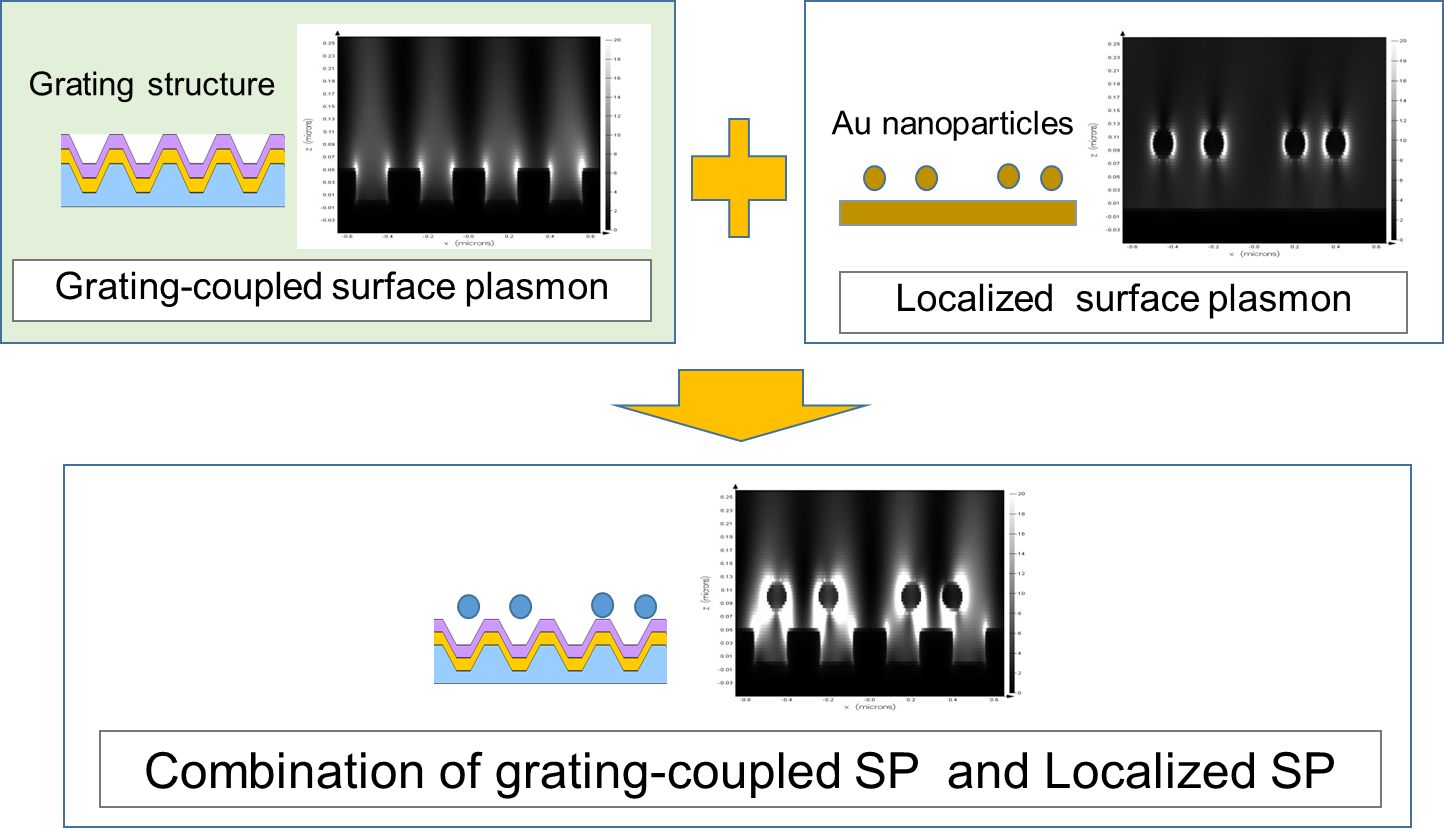
Hybrid propagating–localized modes
Metal nanostructures placed on gratings allow both modes to be excited simultaneously, reinforcing the optical field spectrally and spatially to enhance absorption, photocurrent, heat generation, and sensing signals.
Grating-coupled and localized surface plasmons, and electric-field enhancement through hybridization of the two modes
RESEARCH DIRECTIONS
From interface optics to measurement, conversion, and control.
We conduct research that goes beyond observing optical resonances themselves, combining them with electrochemistry, thin films, organic semiconductors, and nanomaterials to create functional interfaces.
ONE INTERFACE · MULTIPLE FUNCTIONS
Making optical interfaces the center of a device.
We design resonance wavelength, field distribution, optical transmission, absorption, and charge generation as a connected system—advancing from fundamental surface-plasmon spectroscopy to compact sensors and energy-conversion devices.
A
Active optical-interface control
Electrochemical doping of conducting polymers, stretchable gratings, and long-range modes are used to tune resonance wavelength and optical transmission.
B
Compact, multimodal SPR sensing
Transmission SPR, grating prisms, 3D-printed and polymer prisms, and smartphone readout support portable optical sensing.
C
Photovoltaic and photoelectric conversion
Metal nanoparticles and gratings are integrated into organic and perovskite solar cells to enhance absorption and conversion through near fields, scattering, and propagating modes. Plasmonic structures are also applied to photodetection in organic Schottky photodiodes.
D
Photothermal and photoelectrochemical functions
Plasmon-driven heat, hot carriers, and photocurrent are utilized for environmental and energy conversion and for flexible chemical sensors.
RESEARCH TRAJECTORY
How the research has evolved.
Beginning with simultaneous surface-plasmon and electrochemical measurements, the work has expanded to hybrid plasmonics, portable sensing, photovoltaics, photothermal conversion, and photoelectrochemistry.
2006–10
Measuring interfaces in situ
Surface-plasmon optics, electrochemistry, and atomic force microscopy were combined to observe optical and electrochemical responses at conducting-polymer and biofunctional interfaces.
The research progressed from multimode excitation on metallic gratings and electrochemical switching of optical transmission to silver-nanoparticle sheets and simultaneous localized and propagating plasmon excitation.
Transmission SPR, smartphone imaging, and polymer and 3D-printed prisms enabled dual-mode miniature sensors, while localized and grating-coupled plasmons were incorporated into organic photovoltaics.
Recent work combines nanoparticle gratings for photothermal conversion, MOF-modified SPR interfaces, hybrid gold nanostars and nanoparticles, and flexible photoelectrochemical sensing.