01 / EXCITE
Concentrate light with plasmons
Propagating plasmons on metallic gratings and localized plasmons around gold nanoparticles create intense fields close to the photoactive layer.
We combine metallic nanostructures, periodic gratings, conducting polymers, and photoactive interfaces to convert light-driven charge transfer into sensitive chemical and biosensing signals.
Photoelectrochemical sensing reads the generation, transport, and reaction of electrons and holes at illuminated interfaces as changes in current or potential. Independent control of light and electrochemical bias helps isolate interfacial processes while suppressing background signals.
Propagating plasmons on metallic gratings and localized plasmons around gold nanoparticles create intense fields close to the photoactive layer.
Charge transfer in conducting polymers and photoactive materials is extracted as photocurrent or open-circuit-potential changes and coupled to molecular recognition.
SPR, current, and potential are selected as complementary observables to distinguish adsorption, reaction, and interfacial charge transfer.
Rather than observing optical resonance alone, we combine it with electrochemistry, thin films, conducting polymers, and nanomaterials to create interfaces that perform a sensing function.
Nanostructures collect light, functional films recognize molecules, and electrodes read the response. We design these roles as a single interface.
Potential, current, and SPR signals track redox switching, molecular adsorption, and enzymatic reactions in conducting-polymer films in situ.
Polypyrrole, poly(aminobenzoic acid), and PEDOT:PSS serve as functional interfaces for both charge transport and molecular immobilization.
Near-field and absorption enhancement from metal nanoparticles and periodic structures is translated into stronger photocurrent and more sensitive detection.
Au gratings on PDMS are integrated with PEDOT:PSS/AuNP films for sensing on curved surfaces and toward wearable formats.
Beginning with simultaneous electrochemical and SPR measurements, the research has progressed through molecular-recognition films and plasmon-enhanced photoelectrochemistry to flexible sensor devices.
Glucose sensing with N-alkylaminated polypyrrole/glucose-oxidase multilayers and adrenaline detection on poly(3-aminobenzylamine) films established the combined optical–electrochemical approach.
Carboxylated conducting polymers, polyelectrolytes, and graphene-oxide/PEDOT:PSS composite films were developed as EC–SPR biosensor interfaces for immobilizing enzymes and antibodies.
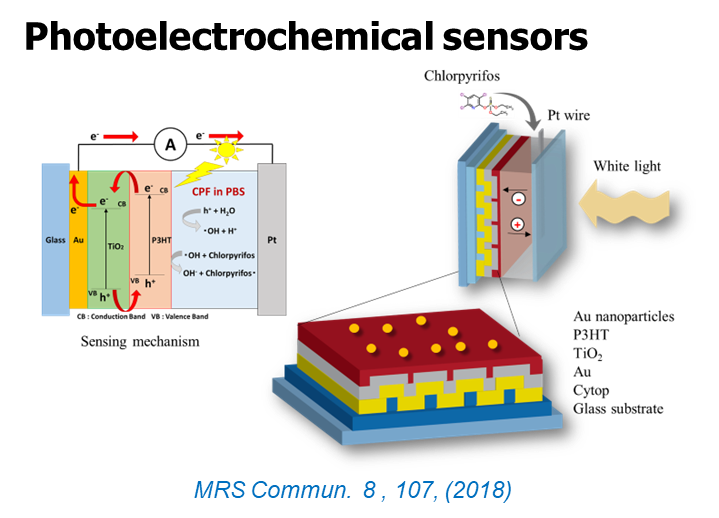
Surface-plasmon resonance was used to enhance a photoelectrochemical response for sensing the organophosphate pesticide chlorpyrifos, connecting optical-interface design to chemical analysis.
PEDOT:PSS/AuNP films were formed on Au/PDMS gratings to combine propagating and localized plasmons with photoinduced charge transfer in a conducting polymer. The platform enables comparison of photocurrent, open-circuit potential, and electrochemical responses.
A photoelectrochemical glucose sensor based on an AuNPs/PEDOT:PSS film and an Au/PDMS grating was reported. Plasmon excitation strengthens the photocurrent response while the thin, bendable architecture advances the platform toward conformable measurement.
We are advancing low-concentration stability, selectivity in complex samples, and flexible miniaturization while deepening our understanding of photoelectrochemical responses for healthcare, environmental, and food analysis.
SENSORS AND ACTUATORS A: PHYSICAL
MRS COMMUNICATIONS
JAPANESE JOURNAL OF APPLIED PHYSICS
JOURNAL OF APPLIED POLYMER SCIENCE
JOURNAL OF NANOTECHNOLOGY · REVIEW
LANGMUIR
ACS APPLIED MATERIALS & INTERFACES
We welcome collaborations that combine plasmonic structures, conducting polymers, electrochemistry, biointerfaces, and flexible devices.
✉ Discuss a collaboration ↗